 Book a demo
Book a demo
Book a demo
Home›Personality
Illustrated scenes keep candidates engaged for the twenty minutes the test takes, and completion rates show it. Every item is a graded choice between two poles of the same trait, so there is no socially right answer to steer toward; faking is designed out rather than corrected afterwards. The instrument measures the Big Five at facet level plus Honesty-Humility, keyed to performance in the role. And the Edge scales find the cases a total score hides: the confident hire who tips into arrogance, or the diligent one who cannot let go.
◆ 01 · What you get
Openness, Conscientiousness, Extraversion, Agreeableness and Emotional Stability, plus Honesty-Humility, each broken down into traits and facets. That is enough resolution to describe a person, not just sort them.
Real behavior is curvilinear: confidence tips into arrogance, diligence into rigidity. Matched adaptive and maladaptive scales at both poles show where a strength turns into a risk.
What someone needs from a role and an environment to do their best work, measured in the same sitting, so fit is part of the picture rather than an afterthought.
Role-adaptive selection reports with interview prompts, and development feedback written for the person rather than the file. Group reports across a hiring wave.
Scores map onto your framework so what comes back reads in your language. Role profiles and cut scores are set with you, and reviewed against your own applicant data.
Candidates whose first language is not English score no differently once you account for who they are; we tested it. Additional language versions are built and validated with you when a program needs them.
◆ 02 · Built against faking
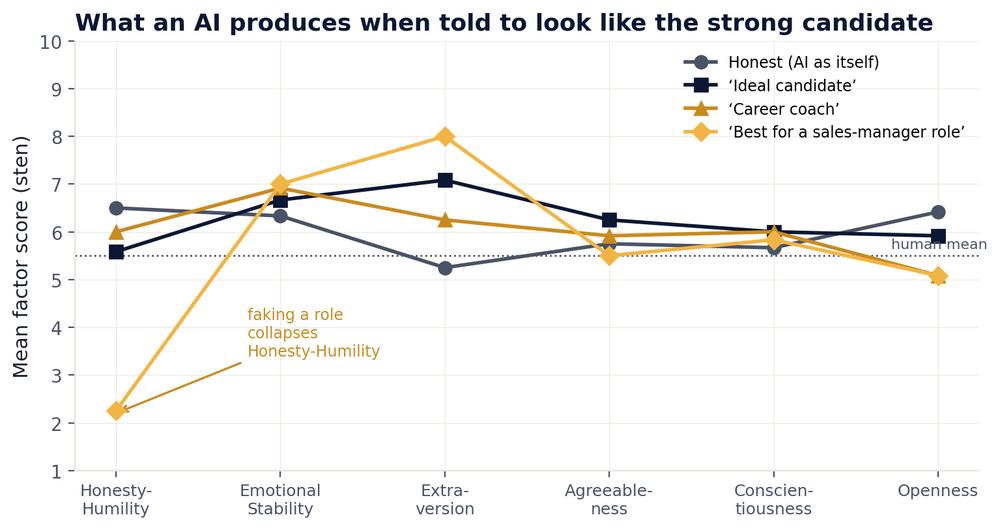
Forced-choice trade-offs mean the candidate is always choosing between two things that are both socially acceptable, which removes the easy inflation of a rating scale. It also defeats the most common form of outside help. We pointed a language model at our own instrument and told it to look like the ideal candidate. It raised itself on the traits the role rewards and paid for them on other traits, because the format makes it choose. Knowing what that trade-off looks like is how you spot it.
The illustrated format lowers the reading load without changing what is measured. Across all 96 items and four demographic groupings, none behaves differently between the illustrated and text-only forms.
◆ Next step
The fastest way to see what this looks like is to give us one job. Send a job description and we'll show you what the first scenario looks like for it.