 Book a demo
Book a demo
Book a demo
Home›Judgment
Filmed, first-person scenarios built from your own critical incidents. The candidate is the camera: they see the customer, the shift, the pressure, and the moment the decision lands on them. They see what the job is really like before they accept it, which means fewer surprised new hires and fewer early exits. And because the scenarios are yours, what you score is the job itself.
◆ 01 · One scenario. Any world.
Once a scenario is validated, our production line can re-skin it for any industry, region or cast. The decision points, response options and scoring keys never change. That is the validity you are paying for, and re-skinning is designed to protect it.
◆ 02 · Built for your job
We start from material you already have: job descriptions, performance narratives, and interviews with the people doing the work. Critical incidents are drawn from that material and mapped to competencies before a single item is written. Then come the scenarios and graded response options, a review covering reading level, bias across six dimensions, social desirability and construct fit, then the scoring key, then the film.
Your material, your competency model, and the measurement plan agreed before anything is written.
Scenarios and graded response options, then the full review battery.
The SME panel derives and approves the key, weighted by expert agreement.
Production, implementation, delivery, with the full technical documentation handed over.
Penalties are weighted by expert agreement. Deviating from a unanimous key costs the candidate; hedging to the midpoint no longer pays. The result is sharper score distributions and more defensible decisions.
One subject-matter expert for a few conversations across the six weeks, and two reviewers to read what comes back. Everything else is ours.
Where each scenario came from, who approved it, how the key was derived, and what the fairness testing found. Most SJTs never get this.
◆ 03 · Why it holds together
Each character is described, approved by a psychologist, then locked. That text drives every frame they appear in, in every language, so the cast never changes between scenes, takes or markets.
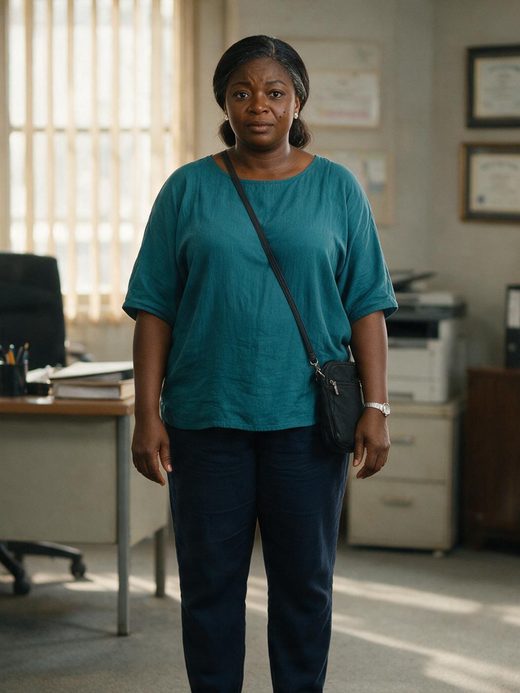
Full build, deep brown skin, hair in a low bun; loose teal blouse, flat sandals, small black crossbody bag.

Medium build, warm tan skin, square face; pressed navy uniform shirt with black epaulettes, steel-rimmed glasses.

Age band 38–42, medium build, dark brown shoulder-length hair; navy blazer over a cream blouse, thin-framed glasses.
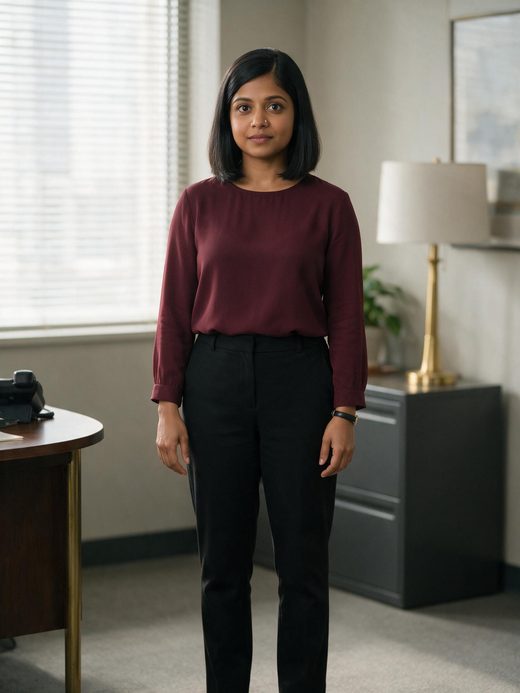
Age band 30–35, petite build, straight black shoulder-length hair; maroon crew-neck blouse, small silver nose stud.
◆ Next step
The fastest way to see what this looks like is to give us one job. Send a job description and we'll show you what the first scenario looks like for it.